Transcription1
Federal Legislature2
HOUSE OF REPRESENTATIVES. ———
SATURDAY, May 3 [1800].
DEBATE ON THE SLAVE TRADE.
The provisions of the bill were, that any American vessel engaged in such trade, if taken, should be forfeited with all her guns, stores, and merchandize, other than slaves. The question for its being read a third time, this day, was carried, and on the question “shall this bill pass?”
Mr. RUTLEDGE. — He had by accident been absent from the House when the present bill was under the consideration of the committee of the whole, and on re- turning to his seat from which he had not been long absent, he found the committee had reported the bill, and the House is now called to decide upon it. From its rapid passage through the committee of the whole he presumed it had not received any opposition, but to him the provisions of it were so objectionable that he could not refrain from resisting its adoption. He had read the bill but once, and wished its third reading by the House had been postponed till Monday, that he might have given it a more attentive perusal and consideration, but the haste with which it was forced forward obliged him to deliver these hasty reflections which had arisen from a cursory reading.
The histories of other countries and other times furnished abundant proof, that the most benevolent intentions and the most humane principles, when accompanied with great zeal, enthusiasm and prejudice were liable to be urged so far as to be productive of much mischief and misery. No evidence was wanting to establish this position, and a recent exemplification of it may be found in the modern history of an unfortunate country of Europe (France) where extreme zeal and enthusiasm had been productive of the extreme of misery. Whenever he was presented with a mea- sure which had any sort of aspect towards a general emancipation, even in its most remote consequences, it was his duty to resist at the threshold, because these con- sequences would prove fatal to the interests of his constituents. He said the bill was defective because in the fourth section it provides that commanders of our cruisers shall capture all vessels with Africans on board and bring them into our ports for condemnation, but the cargoes are excepted, and they must not be brought in. What is to be done with them the bill does not say, and the Secretary of the navy cannot direct without affording to himself a great deal of discretion. As the vessels are to be taken and brought in without their cargoes, he wished to be informed how they were to be disposed of. Are our naval commanders to open a trade with the planters of Cuba or Jamaica, and after having bartered away the Negroes, to bring the vessels home for condemnation? is the government to be thus engaged in a traffic which we are told is disgraceful to individuals? If these people are not bartered away must they be given to the sea? one or the other of these alternatives must ensue, for the slaves are not to be brought into the U. States. In one case the government is to engage in the trade, in the other we hold out to the capts. of our privateers an invitation to murder and massacre. If different States had established the principle of the policy that importations ought not to be made of slaves, the general government in affirmance of that principle had passed a law prohibiting our vessels from carrying on this trade to countries where it is permitted. This he thought was going quite far enough. It might become the ambition society to conjure up projects for proceeding further in the business, but he did not think it became the wisdom of Congress to consume their time in further legislation upon a subject upon which it was impossible to do any thing more which would be effectual. A proof of the difficulty of proceeding further in this business is the defectiveness of the present bill; it is not indeed so very defective as that from the Senate on the same subject, but still it was very defective, although it was the offspring of the wisest heads in the House, his honorable and learned friend from Delaware (Mr. Bayard) was one of the committee which had reported this bill, and its defects proved that the finest talents and soundest judgement when clouded by zeal and prejudice would stray into error. But so difficult is it to proceed further in this business, that notwithstanding the learning and wisdom found in the committee they had been forced to require extrinsic aid, and they had sought it among the gentlemen of the bar of this city, as he had been credibly informed. The result of this auxiliary aid was, that our cruisers were to look out for negro ships, and that when they were captured the slaves were not to be brought in. He was proud of our navy; it was an item in the catalogue of defensive means which he prized most highly, but he would never consent that our navy was to be employed in enforcing the law to which the present was supplemental. The trade was already prohibited, if attempts were made to bring these people here, our revenue cutters would, he hoped, do their duty, and if they were carried elsewhere the vessels in which they were transported would on their return to port be forfeited. This he thought enough, and the constant attempts made in Congress to do more, would he feared, excite the jealousy and uneasiness of our southern citizens. He hoped that spirit would not be roused by the rejection of the reflection he had some days past offered, for amending the fugitive act, and which he had declared to be so defective as to admit of the most atrocious practices.
Mr. BAYARD believed if there was any enthusiasm on this subject it was most evinced by the gentleman who had just sat down, for he had always observed that gentleman to be extremely ardent whenever a subject of the nature was brought upon the carpet. The friends of this bill did not wish it to pass the House if it was liable to the construction that was put upon it: if the gentleman would give himself the trouble to go into the details of this bill, he would find it was not so extremely defective as he now thought, and he believed nothing but a want of understanding could have called forth that character he had given of it. But even if there are such defects, Mr. B. said he was much more disposed to sit down with them than that this iniquitous traffic should exist. The defects imagined may possibly exist in the law, or they may exist in the understanding of the law; he well knew that honorable gentleman’s understanding upon any subject to be as discerning as most gentlemen, but, if he had read it only cursorily, how could he be expected to know the merits of the subject, for he could not attribute to him that intuitive information his friend professed. That which was mentioned was not a defect in the bill, but in the nature of the subject itself, which was certainly very difficult, but he regretted the committee had not been favored with the talents of that gentleman, so that the bill might be put on a better footing than they had been able to place it. The gentleman said that the committee were obliged to have recourse to the bar of this city for information, and yet they had produced but a defective bill; how he got this piece of information Mr. B. could not conceive, but one thing he knew, that while he was pursuing the history of the bill, he had much better have employed his time in studying its details. But this bill was not the offspring of the select committee; it was the offspring of the committee of the whole, and the select committee drew it from that authority. But, said Mr. B. my hon. friend wishes to know what will be done with the cargo, or how the slaves that may be on board are to be disposed of. In this the committee found considerable embarrassment; they thought that the cargo as well as the vessel must be subject to the judgement of a court of admiralty, but it could not be supposed by any man, that the people who were on board could be sent away any where else to be made slaves of. The vessel must be brought here to procure the judgement of a court of admiralty, but the people would certainly never suffer them to be taken away to be sold.
It was observed that slavery was not recognized under our constitution. It was not so, nor by any law of the U. States, but if slaves were brought in under seizures made by our armed vessels, and they were to be told elsewhere, it would be introducing a new principle into our laws, a principle which could not be acceptable to the people. Every gentleman that he had heard speak upon this subject at any time, Mr. B. said, considered slavery as one of the greatest of calamities to this country, and among others, gentlemen whose property lay in it; they consider it as a curse— as a evil that must be endured because it could not be remedied without endangering the peace of the Union; he would join them: he believed a general emancipation would be attended with much evil; but no gentleman had ever wished it to be done, nor had any gentleman ever wished that curse to be encreased by an increase of the number of slaves: no, when these vessels were seized, that every moment would the people be freemen, and they would be brought in here as such, for neither the laws nor constitution recognized the principle of slavery, nor could the laws of any State affect them; they were landed in the U. States, or taken by any of our vessels.
But suppose these people were brought into the United States, they were not imposed upon the States in opposition to their own laws: the States, where importation was prohibited, could not have the people imposed on them; they might be bro’t into Delaware, Pennsylvania and the Eastern States without infringing their laws, and what objection the Southern people could have to that, he was at a loss to know.
A few days since, the House were told that a large proportion of their capital was employed in this iniquitous and dishonorable traffic.
Sir, said Mr. B. are we to regard no principle or honour when money is put in competition with it? Is it possible that the feelings and understanding of this House will ever suffer so much of our capital to go into so disgraceful a trade? Sir, the evil is increasing; it is high time for the government to interfere, for in a few years it would be impossible to say to what length the evil would extend, and then the evil may be past a remedy. As to the immense profits of the trade he did not coincide with some gentlemen; he did not believe but the capital so employed might be used to advantage, perhaps equal, in some other way. It had been estimated, he knew that the loss of the slaves when bro’t into another country, nearly equalled the profits of the sale of them. Of this he could not presume but the commercial knowledge of his friend was aware.
As to the fanaticism which excited this measure, surely the gentleman must have known it o a demonstration or he would not have said it. But whatever his opinion might have been, it was certain that some of the best heads in England had been engaged in the interdiction of this trade, and that the failure of it in the English Parliament was owing to so many gentlemen being personally interested in it. The premier himself was in the minority, which, after every effort had been used, was very small. And yet those great and wise heads were objects of this blind and mistaken zeal, this clouded imagination which the members of this House are unfortunately troubled with. To such a pitch was humanity arrived in the world, that it was impossible to spread the opinion at this day, that colour should deprive men of their rights which God gave them, notwithstanding the error had so long infested the world; no, it was a received principle that no nation could carry on the trade without essentially tarnishing its honor, & England would have put a stop to this commerce but from the idea that some other nations would have carried it on, and the number expected have been the same, while they would have lost the benefits.
In France this traffic was totally extinguished, and who could tell but, if the United States extinguish it also, the practice would become so unpopular as that England herself would also abandon it, and surely gentlemen would pride themselves in such noble example, that would at once destroy a? ? so evil in itself, that we, who hold the principle of liberty so dear should be the instruments of drawing a numerous race of people from their homes, families and all in human life that they hold dear to them, he conceived too absurd to suppose. He was sure this never would be supported if gentlemen would once cast their eyes to the dreadful galling chains lately endured by our white citizens made slaves of in Algiers, where they groaned under the galling chains of their masters, and the cruel lash of their severe hands, when gentlemen considered this and the immense expense of the government to redeem these unfortunate people from their state of vassalage, he could not believe they would advocate the principle in the least.
Sir, said he, is it complexion gives feeling? Is it complexion that shall prevent the exercise of mercy? I trust not. We know the evil does exist, and we know it will exist except a most effectual provision prevents it.
Mr. B. said he was surprised that the gentleman should connect the fugitive act with this subject; he considered the principle entirely different, that certainly did affect the interest of the southern States, but this bill could not; he really believed it would be to the interest of the southern states to prevent this trade, and he hoped gentlemen from those states would lend their hand to its destruction. The object of the committee was to prevent our capital being so employed in so nefarious a trade, when it could be employed more to general advantage, it was also designed to prevent our seamen being so employed. Both these things were provided against; if any new light could be thrown on either of the objects by any amendment that might be proposed, Mr. B. said he Should willingly join any gentleman in introducing it, for he was far from thinking the bill quite perfect.
MR. RUTLEDGE thought he had not merited the charge made against him by his honorable friend of having delivered opinions hastily formed, and of not having given so much investigation to the subject as to enable him to make a correct decision, however crude and erroneous his opinions might be, they certainly could not fairly be deemed in object of the [civic? ] sin of these gentlemen who in their zeal have the bill passed immediately, had refused to give an opportunity for examining its provisions. His understanding as to the subject from having read the bill once was certainly incorrect. He had been drawn into an error by the words of the fourth section which say, the vessels captured under this act. With every thing on board, other than slaves, shall be divided the captors; he had thought the exception would prevent their being introduced into this country, but he now finds it only goes against their being regarded as property, and that they are to be brought into our ports as freemen. Objectionable as the bill seemed to him originally the explanation of its provisions rendered it infinitely more so; from them he had learned that when vessels are captured under the proposed law the cargoes are to be brought into the United States. Naked slaves, who ignorant of our language and business, no talents, the exercise of which will afford the means of subsistence, are to be scattered over our coast. When the best talents in the house are employed in advocating so absurd a project he could not but feel alarmed in contemplating the lengths to which gentlemen might hereafter be carried by their enthusiasm and prejudice. As the migration of people of colour to the southern states is prohibited by those states, it is presumed that vessels captured from Africa will be brought only into the northern states where the negroes will be exposed to the rude effects of a climate vastly more rigorous than their own. What will become of them when landed? who will feed them because they are hungry? who will cloath them because they are naked, and who will take them in because they are strangers? He feared all the Philanthropy of all our abolition societies would be insufficient to procure them food and raiment. He knew that slaves who withdrew from the service of their proprietors were assisted by the pious and charitable because by giving them their labour for a certain time they were very fully indemnified for their affected charity. But the African who may arrive in a perfect state of barbarism will find no charity for him because he cannot pay for it by giving his labour for a term of time. Mr. Rutledge said his learned friend had been pleased to pass compliments on his talents and researches on ordinary occasions, but said they were not discoverable on the present; although his researches were very far from being so profound or general as those of the gentleman from Delaware, yet he felt some confidence in his knowledge respecting this subject. A reference had been made to the British parliament and it had been proudly asked if it would not be flattering to the American pride to have it said, we had by prohibiting this trade given to Europe an example worthy of imitation? It certainly was not in the power of Congress to give this example; for the constitution had deposited for eight years to come the exclusive right of legislating on this subject in the state legislatures.
With respect to the attempts made in the British parliament to put a stop to the importation of slaves into their colonies gentlemen would recollect that the efforts of the advocates of that measure did not go beyond prohibiting the trade to the British islands. Mr. Wilberforce, who was the prime mover and leader in this business, in all his speeches & writings never hinted the policy of preventing British bottoms from carrying for nations which did import. Abolishing the trade to British possessions was all that was aimed at. The conduct of France was also cited— but what was her proceeding on the subject? In all her frenzy of revolution and of producing every where the extreme of liberty, she satisfied herself with prohibiting slavery in her colonies, but did not prevent her vessels in carrying to other nations. Since the revolution they had been employed carrying for the Spaniards to their islands.
Thus it appears that America has already gone further than the nations quoted. Yet we are required to go further because our zeal is greater. Mr. R. insisted upon it that the consequences of this law would be vexatious to the Southern States, for the people brought in under it would be induced, by the mildness of the climate, to reside there. This would excite uneasiness among people of colour in bondage, who might be stimulated to attempt a change of their situation, because there was a class more ignorant who were free. Mr. R. thought the adventuring merchants of the Eastern States would engage in this traffic, however severe the law might be made, because there was none so profitable. He enumerated the places, particularly Liverpool, which had become very opulent by this commerce, and he concluded with observing that all arguments against slavery were irrelevant to the present subject, which merely was whether it was expedient to take Africans at sea and put them on shore in the character of freemen. He thought they would on their in unprotected condition, fall a victim to the climate; but perhaps it would be said hereafter, as it had been said elsewhere, “Let them perish rather than abandon our fine system.”
MR. BAYARD The only, or however the principal objection of the gentleman from S. Carolina appears to have been the bringing slaves into this country—this difficulty might be removed by striking out a single section; but, notwithstanding this was the principal ground, his arguments went against the whole bill. The committee, Mr. B. said, were determined to extinguish this trade altogether if it was possible, and they had produced a bill as near to that object as their information furnished them with the means of, and he thought there was no doubt, when bill took effect, there would not be a single slave carried by any American vessel. To nip the traffic in the bud, and to hold up a punishment in terrorem were the object of the committee; if they had accomplished that, they were satisfied at having done their duty.
Mr. J. BROWN moved an adjournment, but it was negatived without a division.
Mr. B. then observed that this subject of slavery—whether there should be a commerce in slaves or not had been very irritating throughout the United States, and he was very sorry to hear the ingenious and learned gentleman from Delaware using such epithets on the subject as he had done; he wished there might be charity exercised upon each side to the House, he believed there were many good, worthy men that were against slavery, and he should think it but charity in these gentlemen to believe that there were many good and worthy men who believed in slavery. Mr. B. believed there had been slaves from the beginning of the world, & that there would be slaves as long as the world would last—we may stop it in our nation and we may make severe penalties against carrying it on, but we could not prevent it in other nations; indeed it appeared to him wisdom not to touch this matter at all. France to be sure has freed her slaves. but what may be expected as the consequence? Why we may expect to hear of them landing in the southern states of our nation, and there they would find plenty of blacks to join them. Any attempt to prohibit the carrying of slaves from one foreign country to another, he believed it but as wrong as to say that our merchants should not carry molasses or sugar from one country to another. It was well known, that the West Indies could not subsist without slaves, and therefore these attempts were not to injure them but to injure our own commerce, and that very materially. It was no more proper to compel the people with respect to commerce, than it was to force our citizens to go to one particular meeting or church.
Mr. B. observed that the Constitution provided that the slave trade should not be touched till the year 1808, but notwithstanding that, the House were harassed every session with some attempts or other towards its destruction. It was as impossible to prevent this trade as it was, to make a new world, and all efforts would have but one effect, that of injuring ourselves. By these strict prohibitions our best and most industrious young citizens would be driven away to reside in the West Indies, where they could carry on this business because they could not do it at home. He was certain that there was a mistaken policy spread through the house, and wished gentlemen would view the subject impartially and dispassionately. He did not blame men who thought differently from himself, but he was extremely sorry to see a contrary disposition in the gentleman from Delaware.
He did not think it was policy to bring them into this country, call them slaves or freemen, or whatever, it was nevertheless impolitic—think of bringing two or three hundred naked wretches into this country! He scarcely thought there could be a hand held up for it.
Mr. NICHOLAS said as he did not intend, to have taken up a moment on this subject, but some of the principles advanced had compelled him to say a few words on a subject which it was said the Southern States were materially interested in. To say that these people, who were bro’t into the states where there were no slaves, would shun those parts and seek an asylum in warmer climates, where there are slaves, and where they may fear the same fate, was an absurdity he little expected to hear from the quarter it came from. The gentleman farther held up a terrific view of the cargo of 40 vessels being poured upon the shores of the United States, but surely if he was to conceive for a moment that here would be the end of their market, he could not then presume to make it believed that much more of the trade would be heard of. No, one or two experiments would entirely close the business.
Mr. N. was not a little surprised at the horrors expressed by the gentleman from Rhode Island (Mr. Brown) that he should feel so much for our merchants, and so little for these people, is their situation: he thinks nothing of 2 or 300 beings carried into slavery, but shudders at the thoughts of so many being thrown in our community, as members of it merely.
With respect to the principle itself—we have seen the efforts of other countries to stop this trade; we have seen them at the very point of prohibiting their citizens embarking in it. If it should be found at last that all other countries have prevented it, and the United States was the only nation left to carry it on, what will be the reflection? What a disgrace. In his opinion, Mr. N. said it would fix an indelible mark of reproach upon our national character. —He thought the extreme difficulty of reconciling the feelings of the gentleman from Rhode Island, to this prohibition, ought to act as a warning upon the house how they admitted the principle he contended for. —He could only attribute these exquisite feelings to the profits which the gentleman obtained by that trade; if the same disposition should extend to other gentlemen, it could not be ascertained to what length the principle would lead? he did not say it ever would go to that extent, because he believed the gentleman, would not so find many adherents, but if it ever did, all parts of the United States would be engaging in it, and he would wonder if the market did not even extend to the introduction of them as slaves into this country —an event at least to be deprecated, and by every means prevented in due season— It may be as profitable trade, but the personal interest ought to give way to the general prohibition, and no profit reconcile a practice so bad in itself.
Mr. N. believed there was no more dangerous enemies in the world, nor a neighbourhood from which more was to be apprehended than from the West Indies, if they should turn enemies to us. If this was true, it was an important thing to prevent by every means in our possession, the number of blacks increasing in those colonies, lest an event, much to be dreaded, might occur—lest they should be poured in upon our shores, and the direful effects of a general emancipation should be experienced from those which the Southern States have entailed upon them. How had those States hitherto escaped from this weight, overhanging over their heads, but by the prohibition of new importations, and by discouraging the increase as much as possible and diffusing them throughout the U. States? He hoped the bill would pass, and with the clause which gentlemen wished to erase, for that alone would act as an effectual prevention to so immense an evil.
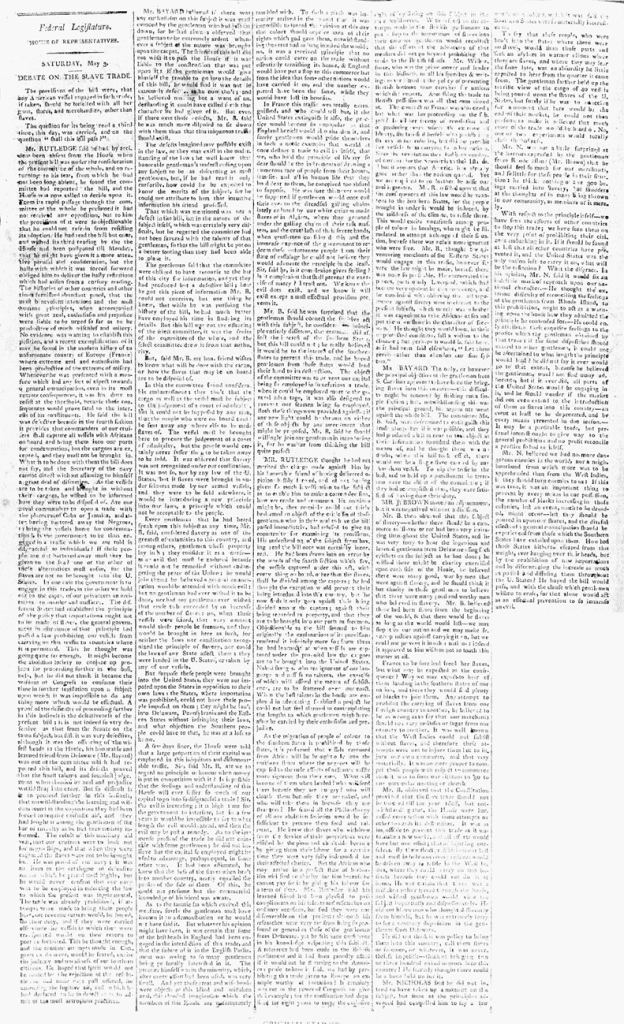
Original3
- Transcription by the author with assistance from ChatGPT5, containing minor changes in punctuation, paragraph breaks and expanded contractions. Otherwise, transcription is (should be) verbatim from the original record (at the end). Please report errors to the author. Version 1.0, August 18, 2025. ↩︎
- The Universal Gazette, Thursday, May 29, 1800, Philadelphia, PA, Vol:II, Issue:CXXXIII, Page:2 ↩︎
- Ibid. ↩︎
 The Ganges Families History Project