
The Schooner Phoebe was taken as a prize by the USS Ganges off Matanzes, Cuba, on the morning of July 21, 1800, two days after the Prudent.1 Neither her ship’s log or port registration records have survived. We know she was from Charleston, with a displacement of 78 tons, but little else.2 The enslaved aboard would have been packed in very tightly, since a vessel bearing 118 slaves would have typically had a capacity of at least 100 tons, given the typical ratio of 1.1 slaves/ton. It was 1.5 in this case.3
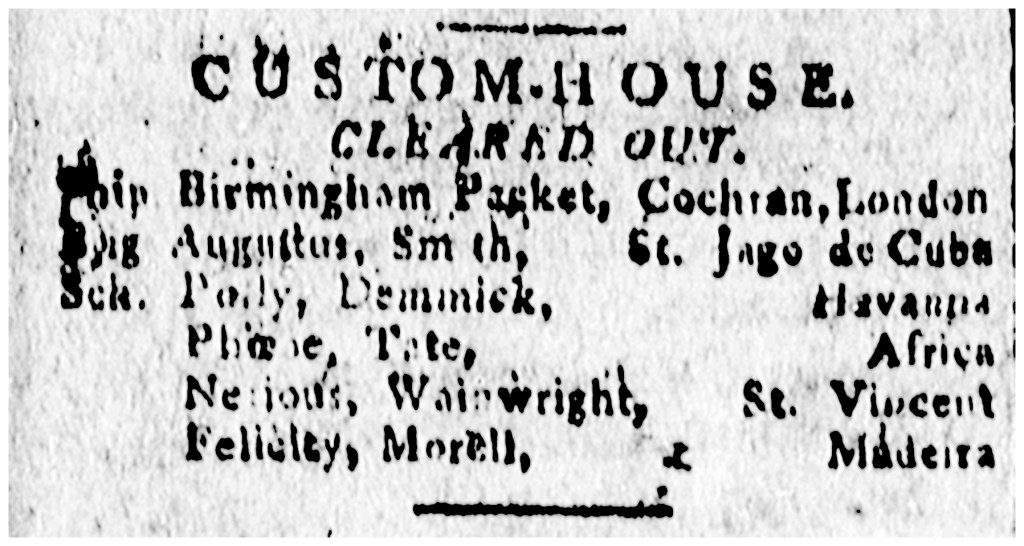
The voyage began in Charleston where, under the command of Captain Tate, the Phoebe cleared for Africa on January 27, 1800, as indicated in the published customs house clearances.4
The captain appears to have changed from Tate to Mills during the voyage. While this might indicate two distinct voyages, the voyage’s six month duration is quite plausible and given that the vessel name, destination and home port all match, a single voyage is more likely. Further, it was not uncommon for captains to die on slaving voyages, or for them to change commands while in Africa, depending on circumstances.5
This wasn’t the Phoebe’s first voyage to Africa. Records indicate at least two earlier ones. The first, conducted between the fall of 1796 and March 1797, under Captain Brodie, took the Phoebe from Charleston to Ilse de Los and back again. Both the South Carolina and Federal laws in effect at the time made the entire voyage illegal, but that doesn’t seem to have had much of an effect. The voyage was duly reported in Lloyd’s Lists (London), but not in any American sources.6
We know considerably more about the second voyage, because it resulted in a serious mercantile dispute between the slave merchants, John and Alexander Anderson of Philpot Lane, London, the agent at their slave factory on Bance Island, Africa, John Tilley, and William McLeod of Charleston, owner of the Phoebe. The Andersons sued McLeod’s estate in South Carolina Court for failure to remit the proceeds due them for the sale of 45 enslaved Africans that Tilley consigned to the Phoebe for sale in Charleston.
The consignment was executed at Bance Island, Sierra Leone, on October 6, 1799, with Edward Welsh, the Phoebe’s captain, signing of McLeod’s behalf. As laid out in the schedule below, the Andersons were to pay costs and a 10% commission to McLeod who was to sell the captives and return the net proceeds to them, precisely estimated at $13,056.30 (more than $250,000 today). The projected costs included an 8% allowance for deaths. The full schedule is shown below.7
| Sales of 45 Negros, on account of John Anderson, Alexander Anderson, and John Tilly. Received from Africa per Schooner Phoebe, Capt. Welsh
1800 – By Sundry – 45 Negros – averaged at $450 | $20,250.– | |
| Charges | ||
| To freight, & provisioning on the Voyage of 45 negros at £10 — or $42.80 p head | 1928.70 | |
| “ Loss occasioned by death — 8 p cent [8%] | 1620.– | |
| “ Cloathing of 45 negros at $6 p head | 270.– | |
| “ Commission for selling, guaranteeing collecting and remitting — 10 p cent | 2025.– | |
| “ Payment of the pilots for landing $2 — | 90.– | |
| “ Agents employed to keep negros till sd[sale?] 3 pct | 607.50 | |
| “ the Capt on the amt. of sales – 3 pct | 607.50 | |
| “ the sum to cover all incidental expenses — | 45.– | 7,193.70 |
| Net Sales | $13,056.30 | |
| Errors Excepted |
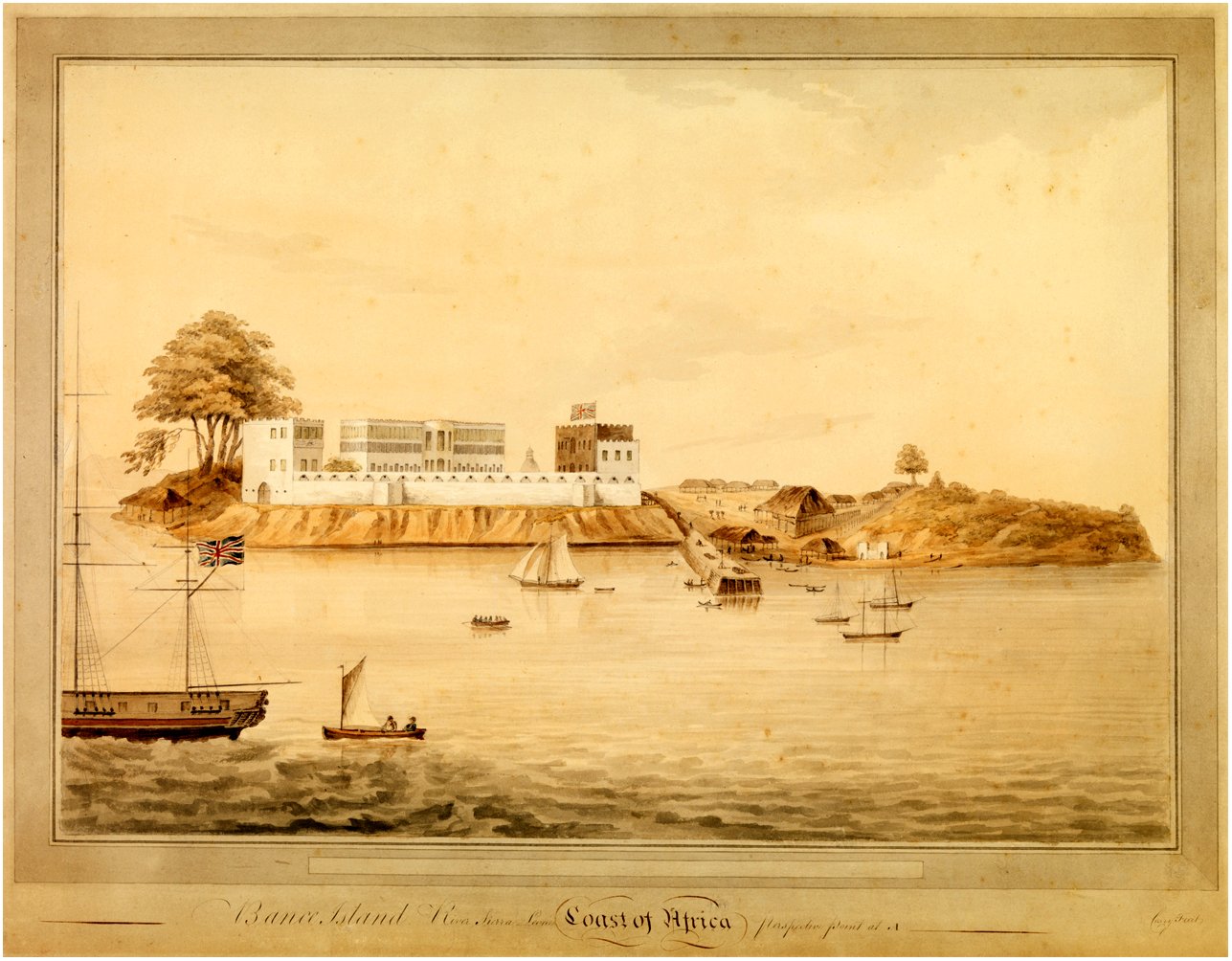
It’s likely the Phoebe left the African coast soon after the consignment, given that it could take up to two months to reach Charleston, longer if the captain chose to go by way of the West Indies, probably to Havana, to sell the Africans. In either case, the Phoebe had barely enough time to return to North America and Charleston, to quickly refit, turn around and head back to Africa the following January (1800). The owners and captain often would try to time a vessel’s arrival in American waters to coincide with the time of highest demand, January to July — planting time, depending on the latitude. This trip, the Phoebe would indeed arrive in July but with an unexpected result for the enslavers.8
It is likely that at least some, if not all, of the enslaved Africans aboard the Phoebe in 1800 embarked from Bance Island. One of the enslavers, Matthias Balthazar, who later sued for the Africans return in Federal Court, had close ties to John Tilley, the factor there. Balthazar was a German slave trader who operated a slave factory situated on Crawford’s Island, one of the Ilse de Los, about 80 miles north of Bance Island by sea.9
In his will, executed in London on December 1, 1798, Balthazar named “John Tilly at Bance Island in Africa” as one of his three executors, instructing him to “to take the care decently to bury my Body and to pay all my just and lawful debts and put everything in good order according to justice[?] and to dispose of the residue of my property in remitting the same to London.” In a later codicil executed shortly before his death in Havana early in 1801, he declares that he possesses “Goods and Chattels these which I have[?] declared to hold in the Island of Bance on the Coast of Africa which I acknowledged before my departure for this City[Havana] agreeably to the laws and customs of the said Island.” He also declares that on arrival in Havana, he had with him “thirty four negroes, my property.”10
CNN has produced a segment titled Rebranding Sierra Leone , documenting a recent visit to Bance Island by reporter Vladimir Duthiers. The ruins there reflect the island at the time of the Phoebe’s visit and provide a powerful reminder of the what happened there.
Captain Mullowny states in his log that the Phoebe was bound to Havana, but owners later argued in court that she was bound for Charleston S.C., only pausing in Cuba – and at Matanzas, not Havana – for repair and provisions.11
Captain Mullowny dismissed that story and ordered Midshipman Calvin F. Stevens and a four-man prize crew to sail the Phoebe to the Ganges‘ home port of Philadelphia. She arrived at Fort Mifflin’s quarantine station on August 4, 1800, to a minor sensation.
The Philadelphia part of the story which continues here.
- “Extract from journal of Lieutenant John Mullowny, U. S. Navy, commanding U. S. Ship Ganges, 21 July 1800 (Off Matanzas) Pleasant Weather — “At ½ past 8 A. M. Made sail in chase of a sail to windward at 10 brought her too she proved to be the Schooner Phoebe Capt. Mills from the Coast of Africa bound to the Havanna with slaves, sent M: Stephens Midshipm” as Prize Master, and with him four Men and ordered her to Philadelphia. [NA.]” Naval Documents Related To The Quasi-War Between The United States And France, 5:163. ↩︎
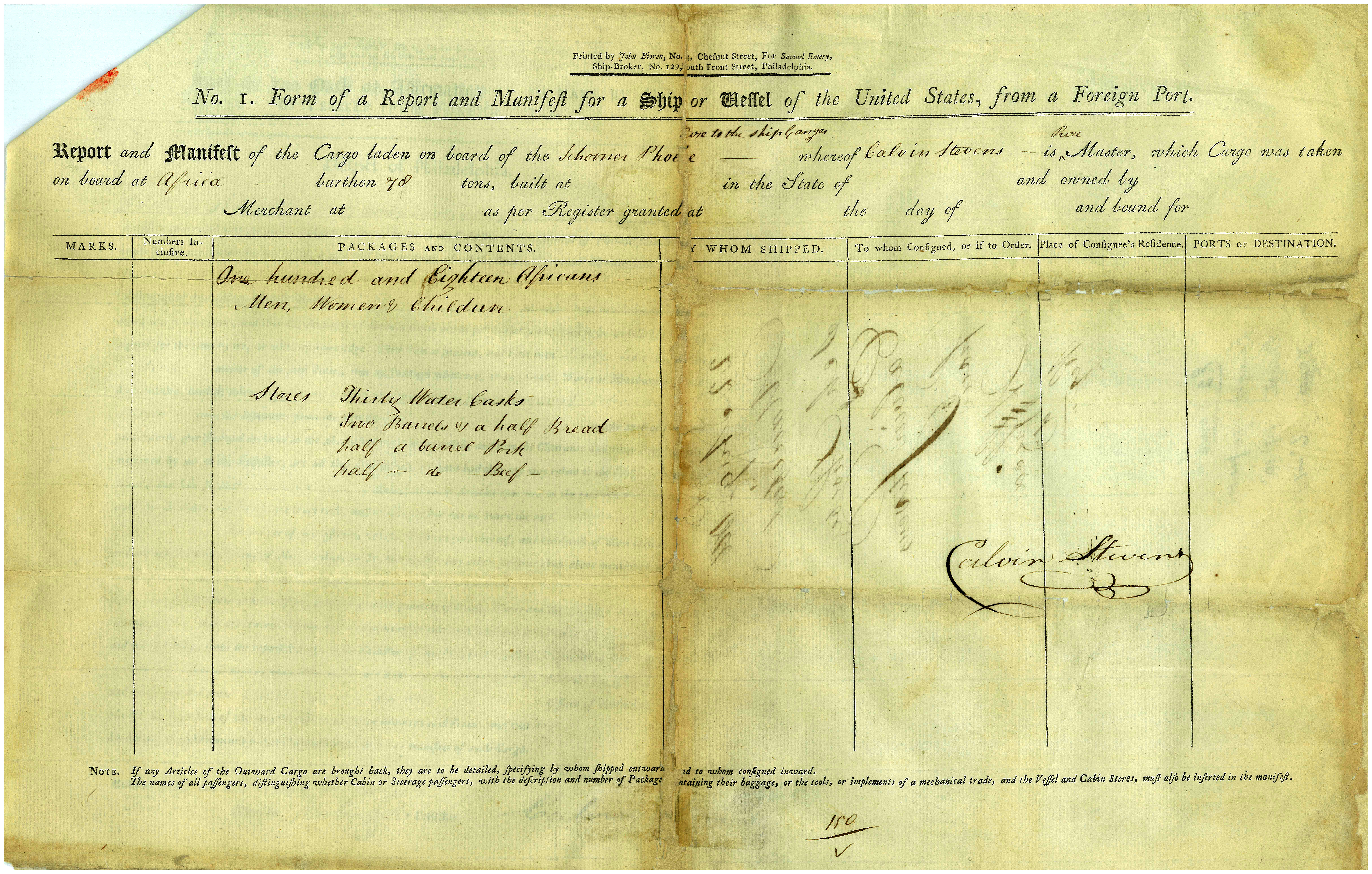
- Department of the Treasury. Customs Service. Collection District of Philadelphia. Office of the Collector of Customs. 7/31/1789-1927, Record Group 36: Records of the U.S. Customs Service, 1745 – 1997, Series: Slave Manifests for the Port of Philadelphia, 8/1800 – 4/1860, Slave Manifest of Schooner Phoebe, NARA Identifier 124218304. The manifest states the Phoebe’s displacement as 78 toms. See below:
 ↩︎
↩︎ - Jay Coughtry’s database uses a ratio of 1.1 slaves/ton to estimate slave counts when only the vessel displacement is available. ↩︎
- South Carolina State Gazette. and Timothy’s Daily, (Charleston, SC), 27 Jan 1800, page 3. ↩︎
- In the years from 1801 to 1807, one in seven slaving captains died on the voyage. See Rediker, Marcus, The Slave Ship: A Human History (New York, Viking, 2007), pp 197-198. ↩︎
- Lloyd’s List 10 Jan and 31 Mar 1797. See: https://babel.hathitrust.org/cgi/pt?id=mdp.39015073721238&view=1up&seq=14 and https://babel.hathitrust.org/cgi/pt?id=mdp.39015073721238&view=1up&seq=58 accessed 18 Oct 2022. ↩︎
- Charleston District Court of Equity, Bills, 1806 No. 29, John and Alexander Anderson and John Tilly vs. John Moncrieff CH174. ↩︎
- Coughtry, Jay, The Notorious Triangle, Rhode Island and the African Slave Trade 1700-1807, Philadelphia, Temple University Press, 1981, p54. ↩︎
- Like Bance Island, the Ilse de Los was a bulking center to which enslaved Africans were brought by local traders and then sold or consigned to slaving captains with the center’s factor taking a percentage. This allowed quicker turnaround than if the captain did the buying from the locals himself. See: Mouser, Bruce J., Iles de Los as bulking center in the slave trade, 1750-1800. ↩︎
- Balthazar(Rehm), Mathias, Will of Don Matthias Bathaser or Balthazar Rehm of Africa, 10 October 1801, National Archives, Kew, PROB 11/1364/153. ↩︎
- William McLeod to William Tilghman, 18 April 1801,William Tilghman Correspondance, Historical Society of Pennsylvania (0659).
↩︎
 The Ganges Families History Project