From its very beginnings in 1772, the Abolition Society’s efforts to assist Philadelphia’s blacks were conducted within the laws and traditional practices of the city and the State of Pennsylvania. The Society also reasoned that it was not enough to secure a person’s freedom, but that they must be afforded the opportunity to live a productive life as free persons of color. Being free with no means to support meant that they would in all likelihood end up in the alms house, or worse.
Consequently, in many cases, the Society’s Committee of Guardians would arrange for blacks to be indentured to masters throughout the Philadelphia area. Indenturing was most commonly used as a mechanism for free white immigrants to secure passage from Europe to Philadelphia where the indenture they signed upon departure would be transferred (i.e. sold) to a master upon their arrival in America. After satisfactorily completing an agreed-upon term of service (typically, several years), their servitude would end, effectively paying for their passage.
In the Ganges’ case, the objective was somewhat different, namely that each person be taught a trade, to read and write, to receive clothing at the end of their service and occasionally a cash payment. These terms more closely resemble those of an apprenticeship, although the most common trades taught were farming for males and housewifery for females. A less common feature is a clause preventing the indenture’s transfer without the Abolition Society’s consent. This helped prevent the Ganges coming under the legal control of disreputable masters who might not be willing or capable of fulfilling the indenture’s terms or who lived out-of-state and beyond the reach of Pennsylvania law.
A unique clause was added to the indentures for those captives who arrived aboard the Phoebe because their enslavers had challenged the District Court’s decision to free them. Each master and/or a second party was required to post a $400 bond guaranteeing the Ganges’ return if they were found to be enslaved.2
The Society used this tactic repeatedly throughout its active phase (1772-1820), typically arranging several indentures a month. In the Ganges’ case, they managed to execute well over a hundred in just a few weeks. The special committee clearly needed to call upon the Society’s members and their extensive religious, family, and commercial networks to recruit and enlist this unprecedently large cohort of masters and bond underwriters in such a short time.3
The Committee reported its results to the Society as a whole in March,1803 (transcription below):
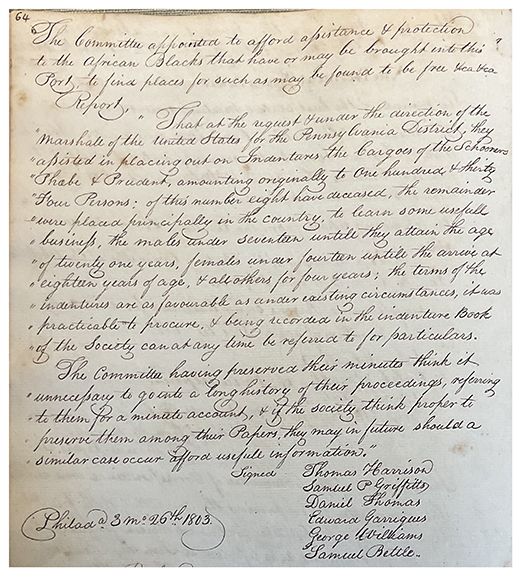
The Committee appointed to afford assistance and protection to the African Blacks that have or may be brought into this Port, to find places for such as maybe found to be free etc. etc.
Report,
That at the request and under the direction of the Marshall of the United States for the Pennsylvania District, they assisted in placing out on Indentures the Cargoes of the Schooners Phoebe and Prudent, amounting originally to one hundred and thirty four persons; of this number eight have deceased, the remainder were placed principally in the country to learn some useful business, the males under seventeen until they attain the age of twenty one years, females under fourteen until they arrived at eighteen years of age, and all others for four years; the terms of the indentures are as favorable as under existing circumstances, it was practicable to procure, and being recorded in the indenture Book of the Society, can at any time be referred to for particulars.
The Committee having preserved their minutes think it unnecessary to go into a long history of their proceedings, referring to them for a minute account, and if the society think proper to preserve them among their Papers. they may in future should a similar case occur, afford useful information.
Signed Thomas Harrison
Samuel P Griffitts,
Daniel Thomas
Edward Garrigues
George Williams
Samuel Bettle
Philadelphia third month 26th 18034
Examples
Below , you will find representative examples of both an indenture and a bond for Maria Ganges and her master Daniel Thomas. Mouse over the highlighted sections for some additional explanatory text.
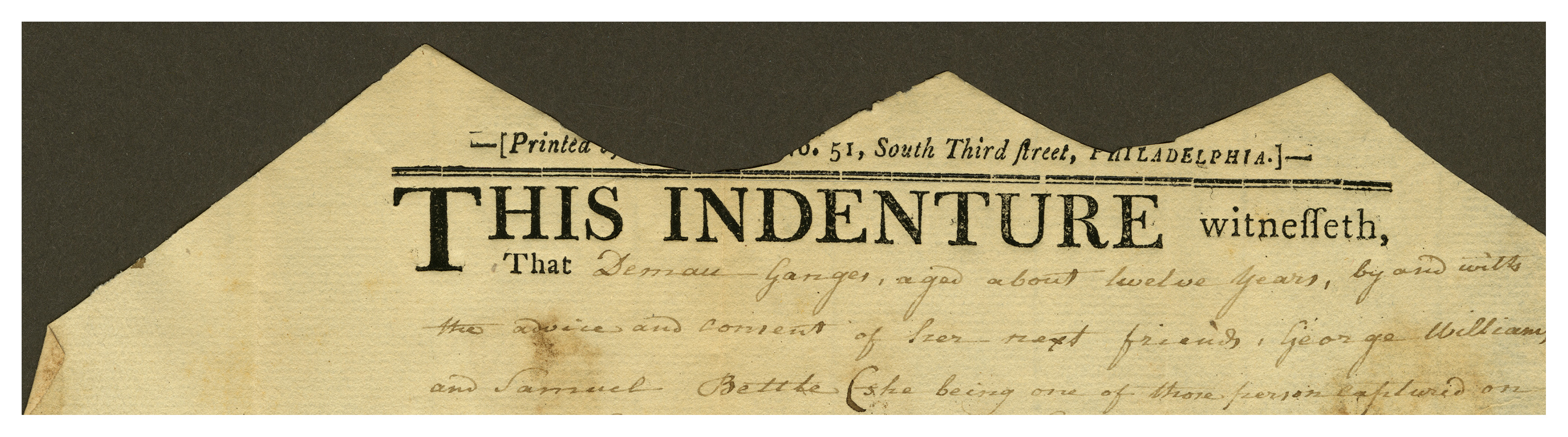
Indenture Example
The image below is an example of Indenture between Maria Ganges and Daniel Thomas, October 1800.5 It uses the standard boilerplate form created by the Abolition Society and used for indentures of the Phoebe’s captive Africans. Mouse over each highlighted area to see a short discussion of the key elements as outlined above.
Bond Example
The image below is an example of the bond executed by Daniel Thomas and Joshua Longstreth on October17, 1800.6 It uses the standard boilerplate form created by the Abolition Society and used for the bonds guaranteeing the return of each of the Phoebe’s captives if they were found to be slaves. Mouse over each highlighted area to see a short discussion of the key elements as outlined above.
References
- Records of the Abolition Society of Pennsylvania, HSP Collection 490, Box 2 Folder 14. ↩︎
- This places the value of the Phoebe’s “cargo” around $45,000, well over a million dollars in today’s currency. ↩︎
- Discussions of the abolition movement commonly emphasize the importance of personal networks in its development, with these network’s often operating over decades. In the Ganges case, we have an instance where a network of specific individuals becomes visible at a point in time. There are scores of family relationships among the masters of the Ganges. This is a fascinating opportunity for future research. ↩︎
- Records of the Abolition Society of Pennsylvania, HSP Collection 490, “General Meeting Minute Book, 1800-1824′, Ams.011, page 64. ↩︎
- Records of the Abolition Society of Pennsylvania, HSP Collection 490, Box 3A Folder 2. ↩︎
- Records of the Abolition Society of Pennsylvania, HSP Collection 490, Box 3A Folder 2. ↩︎
 The Ganges Families History Project